How to Plan a Wedding in 6 Months: A Week-by-Week Plan
To plan a wedding in six months, book the venue and caterer in the first two weeks, lock the guest list and invitations by week six, and treat everything that needs a long production time as optional. You are not behind; you are compressing the standard 12-month order into half the time. The steps stay the same, the gaps between them shrink and every decision needs an owner and a date.
The compressed timeline
| Weeks | Focus | Must finish |
|---|---|---|
| 1 to 2 | Budget, guest range, date and venue | Signed venue, deposit logged |
| 3 to 4 | Core vendors | Caterer, photographer, music booked |
| 5 to 6 | Guests and attire | Guest list drafted, invitations sent |
| 7 to 12 | Details and wedding party | Ceremony plan, menu, decor, rentals |
| 13 to 18 | Logistics | Seating, schedule, final fittings |
| 19 to 22 | Confirmations | RSVPs closed, final counts, payments |
| 23 to 26 | Final month | Handoff, packing, rest |
Weeks 1 and 2: decide the shape
Agree on the total budget, who contributes and a guest range. With little time, flexibility is your leverage: be open to a Friday, a Sunday or a smaller venue, because those dates are more likely to be free. Ask each venue what is included so you do not book twice, then sign and log every deposit and due date in a payment list the same day.
Weeks 3 and 4: book what sells out
Catering, photography and music go first. If your venue bundles a caterer, that is one decision saved. Send inquiry emails in one batch and ask for availability, a quote and the payment schedule. Keep every vendor in one list with the next action and deadline, so a quote does not sit in an inbox.
Weeks 5 and 6: guests and attire
Build the guest list with household, contact details and RSVP status. Send invitations right after the date and venue are firm and ask for replies about four weeks before the day. Attire with long lead times should be ordered now; if a dress or suit cannot arrive in time, choose off-the-rack or a rental with alterations. See the wedding guest list template workflow.
Weeks 7 to 12: the details that matter
Choose the ceremony structure, the menu and the decor that your venue allows. Short timelines reward simple decisions: fewer decor elements, a menu the caterer already does well, and playlists in place of live bands if availability is tight. Ask your wedding party to take specific tasks with dates.
Weeks 13 to 22: logistics and confirmations
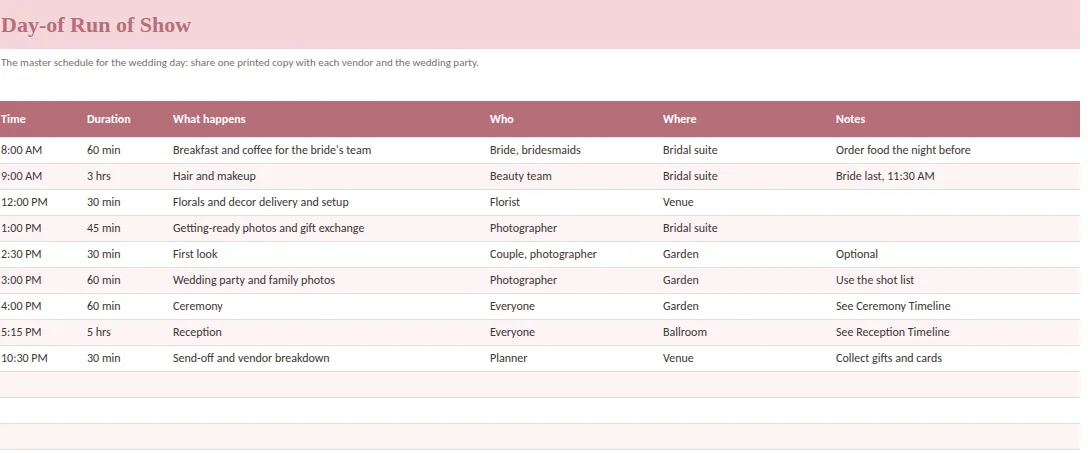
When RSVPs arrive, assign tables and record meal choices. Draft the wedding-day timeline from the ceremony time backward and send it to vendors for their feedback. Confirm every final balance. Use a day-of timeline so everyone knows their arrival time.
The final month
Confirm the headcount, pay final balances, pack bags and print the schedule. Name one helper who can answer questions while you are getting ready.
What to drop on a short timeline
- Custom stationery that needs long production
- A separate engagement event
- Complex DIY projects
- Anything that needs a vendor you have not booked yet
A planner that already knows the clock
Short timelines punish disorganization, so the tool matters. The Ever After Wedding Planner calculates a suggested date for each of its 120 checklist tasks from the wedding date you type on the Dashboard, and the Dashboard shows days to go and weeks to go. If you have six months, tasks whose suggested dates have already passed are easy to spot and fold into the first weeks. Budget, payments, guest list, seating and vendors are in the same 33-tab workbook, which opens in Google Sheets, Excel and Numbers. A printable planner PDF is included, for $34.80 one time. Change the sample dates before you rely on the schedule.
A weekly rhythm for a six-month plan
Twice a week, fifteen minutes: update statuses, log payments and pick the next three tasks. On the weekend, one longer session for vendor emails and decisions. The compressed plan works because small regular steps replace big last-minute ones.
Questions to ask every vendor on a short timeline
Short timelines go smoother when you ask the same five questions of every vendor and write down the answers:
- Are you available on my date, and for how many hours?
- What exactly is included in the quote?
- What is the deposit, and when is each later payment due?
- What do you need from me, and by when?
- What is your cancellation and rescheduling policy?
Record the answers next to the vendor name. When a vendor replies with a quote and nothing else, the missing answers are the next task. Asking early also shows you who responds quickly, which matters more than a small price difference when you only have months.
Three decisions that save weeks
- Decide the guest range this week. Nearly every venue conversation depends on it.
- Accept the first good venue that fits. Touring ten places is a luxury a six-month plan cannot afford; three is plenty.
- Delegate in writing. A task given to a relative should have a deliverable and a date, not just a name.
Where to look next
If you want the full-year version for reference, see the wedding planning checklist by month. For a complete order of decisions, read how to plan a wedding.